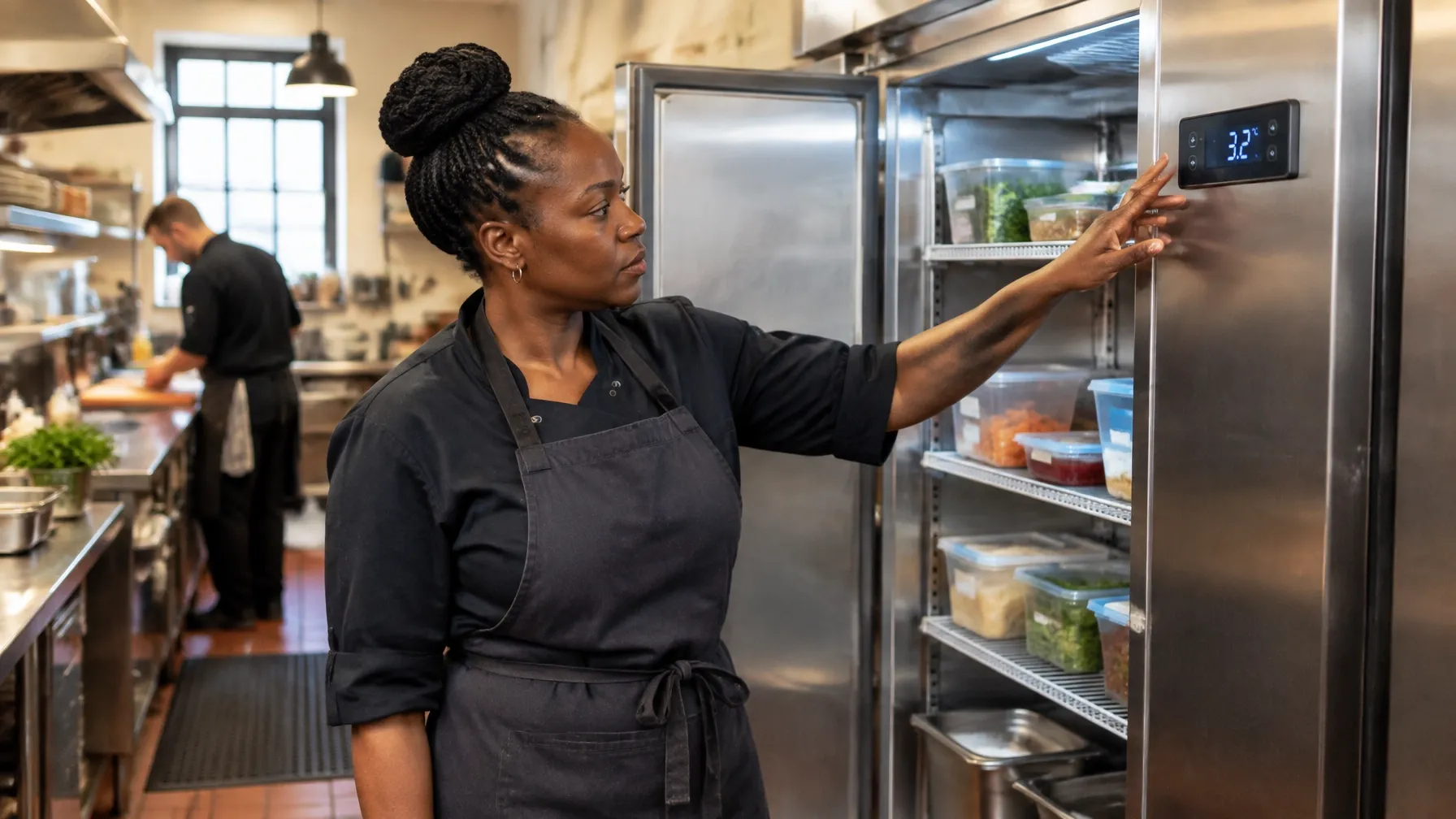
You didn’t fail at AI. You hired it badly.
And perhaps you have hired your compliance records badly too.
The fridge temperature log is blank since Tuesday. The cleaning checklist is somewhere under a stack of invoices. Nobody knows who was meant to sign the safety record, so everybody assumes somebody else did it.
Then an inspection gets mentioned.
Suddenly, that innocent little sheet becomes the most important piece of paper in the building.
Hey boo, I’ve got you. You do not need a binder the size of a small wardrobe. You need a record-keeping routine that fits the way your business already works.
If you serve food in the UK, you likely have record-keeping duties as part of your food safety management system. The exact requirements depend on your business, location, and procedures. Check current guidance with the Food Standards Agency and your local authority.
This is general information, not legal advice.
Here is the no-faff method.
Your fridge temperature log needs one simple checklist
Do not start by creating twelve new forms.
That is how good intentions turn into a folder nobody opens.
Create one simple checklist for the daily records you genuinely need. For a small pub or restaurant, that may include:
- Fridge or cold storage temperature
- Freezer temperature, if relevant
- Key cleaning tasks
- Any immediate safety issue
- The name or initials of the person completing the check
- Corrective action if something is wrong
For a salon, your checklist might cover cleaning stations, disinfecting tools, waste handling, equipment checks, and any other records required for your operation.
The important bit is that each entry should be useful. A tick that says nothing is not helpful. A short entry with a date, time, actual reading, initials, and action taken gives you a much clearer record.
Your checklist does not have to replace the food safety management system or procedures your business needs. It simply makes the daily routine easier to complete.
A fridge temperature log should record the actual reading
Do not write “fine”.
Write the actual temperature, such as 4°C, along with the date, time, fridge identifier, and initials.
If the temperature is outside your business’s safe operating range, record what happened next. That may mean checking the door seal, moving food, contacting an engineer, or following your existing food safety procedure.
The response depends on your system and the risk involved. Do not let a chatbot invent the corrective action for you.
Attach the checklist to something you already do
The biggest problem with compliance records is usually not laziness.
It is memory.
You are already opening the pub, preparing the kitchen, setting up the salon, counting the till, checking deliveries, or locking up at the end of a long day.
So attach the record to one of those routines.
For example:
- Fridge checks happen during opening
- Cleaning checks happen during closing
- Equipment checks happen before the first appointment
- The weekly review happens every Friday before payroll
- Delivery records are completed when the delivery is put away
Do not create a new task called “remember the log”.
That task is doomed.
Instead, make the log part of a task that already exists. The fridge check becomes part of opening. The cleaning sign-off becomes part of closing. The person holding the keys knows it is part of getting the business ready.
The best fridge temperature log is the one people see
Put the checklist where the work happens.
That could be beside the fridge, near the cleaning station, by the salon reception desk, or next to the opening and closing checklist.
Not in a drawer.
Not in a shared drive called “Important Admin 2024”.
Not in a folder that only the accountant can find.
If you keep records electronically, make the same principle apply. Use one clearly named file or form that staff can access quickly. The location should be obvious enough that a tired person can find it without asking you.
Name one person who owns the record
“Everyone is responsible” often means nobody is responsible.
Choose one named person for each routine. That could be the opening manager, shift leader, salon manager, or business owner.
This does not mean that person must personally complete every entry forever. It means they are responsible for making sure it happens.
They know:
- What needs checking
- When it needs checking
- Where the record lives
- What to do if an entry is missed
- Who covers the task when they are away
You can still delegate the actual reading or cleaning task. Just make sure the ownership is clear.
Illustrative scenario: A pub’s opening manager checks the fridge temperature before service. If they are off, the named cover person does it. The owner reviews the completed records once a week. No dramatic meeting. No guessing. Just a clear handover.
Make every entry take 30 seconds
If a single record takes five minutes, people will avoid it when the bar gets busy.
Keep the entry short.
A useful fridge temperature log entry might look like this:
Date: 24 September 2026 Time: 10:05 Unit: Fridge 1 Reading: 4°C Initials: AB Action: None
If there is a problem:
Reading: 9°C Action: Food moved to Fridge 2. Manager contacted. Follow-up required.
That is it.
You are not writing a novel about the fridge.
Cleaning records should be equally straightforward. List the task, date, initials, and any problem that needs attention. Keep detailed instructions in your written procedure, rather than forcing staff to copy them into every daily entry.
The goal is not to create impressive paperwork. The goal is to create a record that reflects what actually happened.
Review the records for five minutes each week
Daily completion is only half the job.
Once a week, spend five minutes looking for gaps and patterns.
Ask:
- Are any days missing?
- Is one fridge regularly running warmer than the others?
- Are cleaning tasks being skipped on a particular shift?
- Are the same issues appearing again?
- Does somebody need clearer training or cover?
- Is the checklist still realistic?
This is where a basic log becomes useful management information.
You are not just proving that a check happened. You are spotting small problems before they become expensive, stressful ones.
Free AI helps with the admin around the record
This is where AI can genuinely help, without pretending to be a magic compliance officer.
You can use free AI tools to:
- Turn a quick voice note into a dated log entry
- Flag missing days in a spreadsheet
- Draft a short weekly summary
- Make records easier to search
- Pull out repeated issues for your review
- Turn messy notes into a consistent format
Illustrative scenario: A salon owner finishes closing and says into their phone, “Thursday, 24 September. Reception cleaned, tools disinfected, towel cupboard checked, no issues. AB.”
AI could turn that note into a tidy dated entry for review and filing.
But you still need to check it.
AI may misunderstand a date, mishear a temperature, or tidy up a detail that should not be tidied. It cannot take the actual temperature. It cannot inspect whether a surface is clean. It cannot honestly sign something off on behalf of a person who did not do the check.
A human must do the reading, the check, and the sign-off.
That limitation matters.
At Phare HR, we teach this through Amplified Impact, our practical approach to using fewer tools properly. With Back of House by Phare HR, the focus is simple: AI staff, set up and managed.
AI can help organise the paperwork around the work. It cannot do the work you did not ask a human to do.
Do not use AI to invent missing records
This needs saying plainly.
If the log is blank since Tuesday, do not ask AI to fill in believable temperatures for Wednesday and Thursday.
That creates a tidy-looking fiction, not a compliance record.
Instead, mark the gap honestly. Note what you know. Complete the next check properly. Then review why the gap happened and fix the routine.
A transparent record with a clearly noted missed day is safer than a perfect-looking record that nobody can support.
You can also ask AI to help you create a simple checklist, rewrite instructions in plain English, or draft reminders. Just keep a human in charge of the facts.
FAQ about the fridge temperature log
How often should I check my fridge temperature?
The correct frequency depends on your documented food safety procedures, the type of business, and the risks involved. Daily checks are commonly built into food business routines, but you should follow your own food safety management system and current advice from the Food Standards Agency or your local authority.
Can AI complete my fridge temperature log for me?
No. AI can help format a voice note, identify missing entries, and draft a weekly summary. A human must take the actual reading, carry out the check, and sign it off honestly.
What should I do if my records are already missing?
Do not backfill invented information. Start recording from the next check, mark any known gaps clearly, and review the routine with the person responsible. If you are concerned about your compliance position, speak with your local authority or an appropriate food safety professional.
You do not need more paperwork. You need ownership.
One checklist.
One routine.
One named owner.
Thirty seconds per entry.
Five minutes each week.
That is the system.
If you want help working out where AI can support your real admin without taking over decisions that need a human, book your free 20-minute AI education call with Amber.
There is also a free class on Friday 25 September 2026, from 12:00 to 13:30 BST. You can join here: https://calendly.com/amberaziza/ai-for-your-business. See you Friday.
You’ve got this! XO, Amber.